
If you’re reading this, thank you and welcome.
By now, many of us have read numerous eloquent reflections on 2025, a year defined by uncertainty. Only a few weeks into a new year, the headlines scream of more befuddling, if not catastrophic, worldwide events. It’s no surprise that people are unsettled and seeking information and connection.
Many of us turn to doomscrolling, seeking to stay informed or find comic relief, if only to receive the briefest hit of dopamine and a promise of connection. The endless stream of crises that our phones alert us to pulls us away from the present moment and from one another, under the guise of staying informed.
More than ever, it’s important to remember a timeless and invaluable tool—the radical act of slowing down and seeing.
The renewed popularity of paint-by-number kits and jigsaw puzzles points to a human instinct, particularly during the colder months, to create without friction, to focus without interruption. These acts of intentional slowness create a brief but meaningful pause, allowing one to think, feel, and reflect. For those of us too tethered to our phones to open a mindfulness coloring book, there are places to go.
Across the city, cultural and public spaces play an increasingly important role as places to slow down and unplug. Museums, libraries, parks, and public artworks offer opportunities not only to encounter art, but also to encounter each other—sometimes unexpectedly. (This author ran into two friends, one from Boston, one from Mexico, standing in front of a Mark Bradford painting at MoMA.) Our daily commutes and shared winter rituals, such as skating on the Frog Pond or sledding in Franklin Park, offer more opportunities to gather perspective.
An even more accessible opportunity to combat the feeling of overwhelm is through intentional seeing. Take a tip from Visual Thinking Strategies (VTS). Try this the next time you’re stuck in traffic: look at an object near you and ask yourself, What do I see? Then ask, What do I see that makes me think that? This simple exercise can open surprising paths of thought and conversation. Seeing, it turns out, is not passive—it’s an active, creative act.
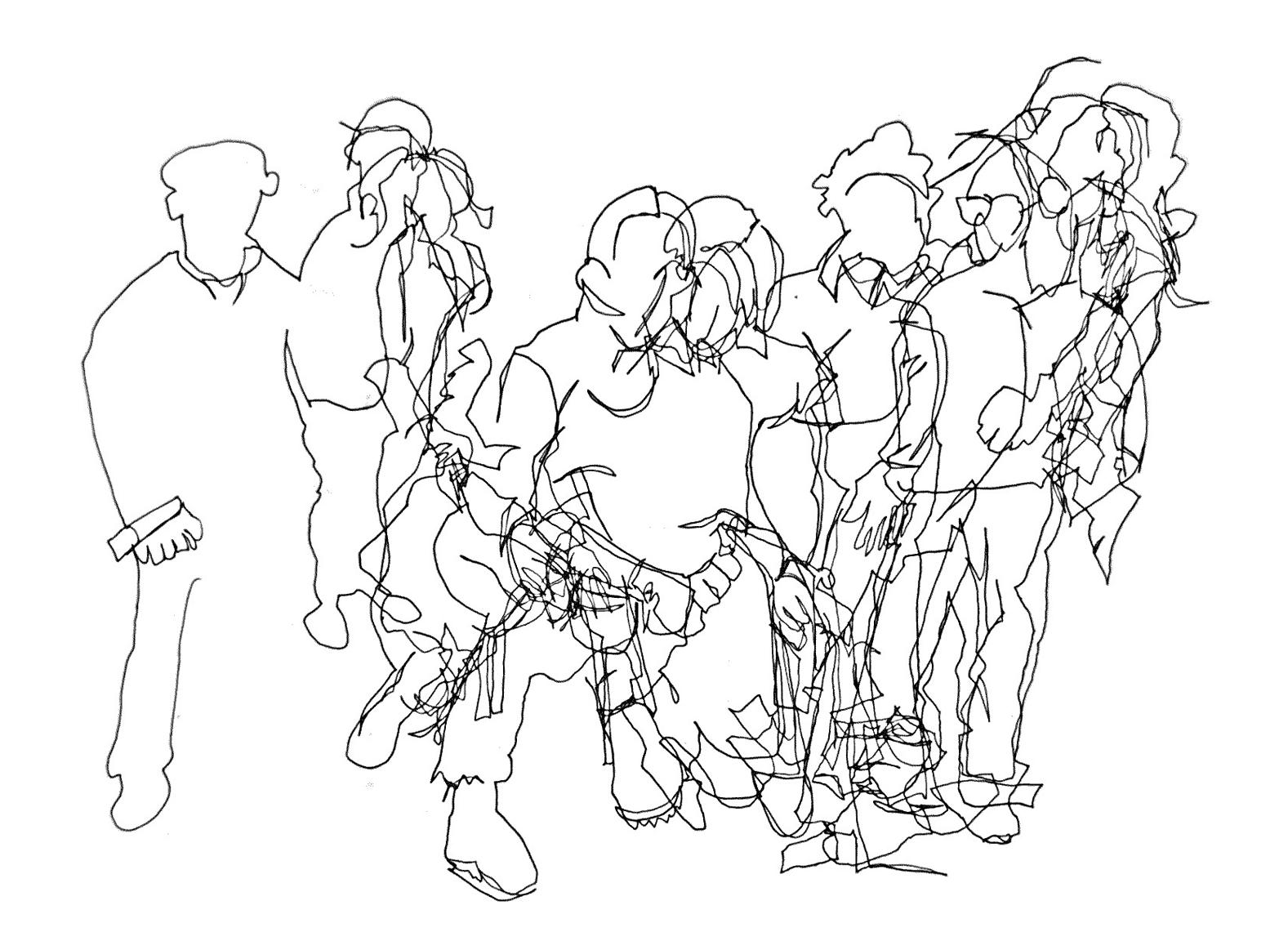
A blind contour drawing of The Triennial team.
Seeing is better when we do it together. Like sharing a delicious meal or enjoying a favorite melody, collective experiences deepen our sense of connections. When we see and learn together, dopamine and serotonin levels rise. We feel relaxed and more grounded. And another thing happens — a community starts to build.
This is where Boston Public Art Triennial comes in.
We exist to offer these moments of presence, curiosity, and shared experiences. Our shorthand and guiding principle: we open minds, conversations, and spaces. Triennial 2025, a free citywide public art exhibition of 24 artwork sites, provided these moments. Adela Goldbard’s fiery effigy of a colonial ship — inviting reflection on history, power, and possibility — offered a glimpse of hope alongside provocation. We’ll continue to deliver these moments in 2026.
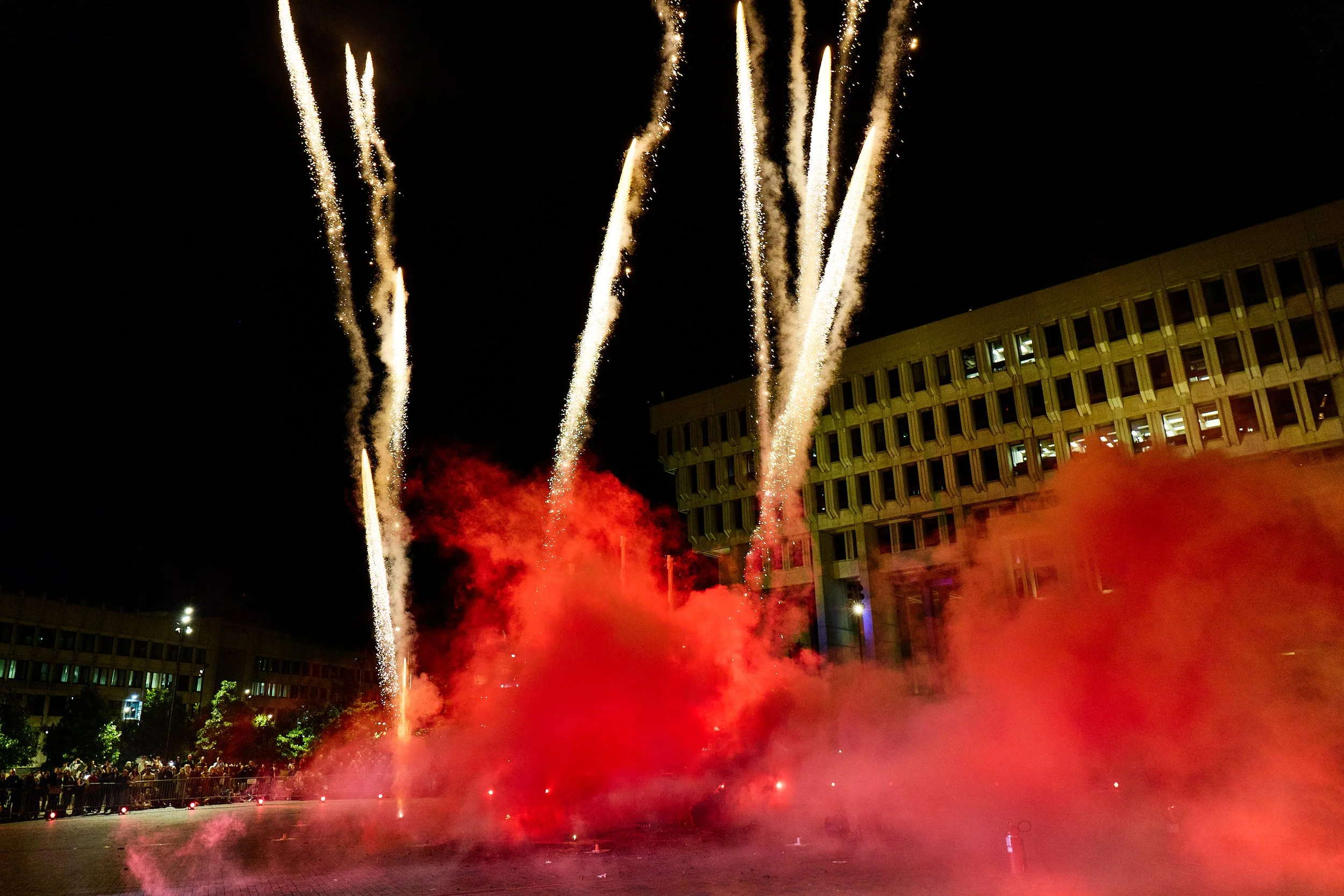
Adela Goldbard’s Invadieron por mar, respondemos con fuego. Un presagio. at City Hall Plaza, Boston, presented as part of Triennial 2025. Photo: Robert Gallegos.
The Triennial is using the winter months to creatively translate the success of Triennial 2025 and our 10-year history into events, conversations, and a prophetic artwork in 2026. We’re asking ourselves, What more can we find in this picture? During this time, we look to you and ask what you’re seeing.
What types of free art experiences interest you? What would you spend your precious time attending?
We invite you to share your thoughts in this survey, open through February 29, and join us in creating an inclusive environment that fosters complex thought and conversation.
With your insight, we’ll work towards our shared vision of a vibrant, open city by fostering five local ambitious artists and amplifying partner offerings. All, always free of charge.
We’ll start in April by gathering audiences for public experiments in seeing and reflecting. In June, as revolutionary fervor mounts with the 250th anniversary of our country’s founding, multimedia performance artist Heather Kapplow will invite audiences within a playful environment to share their burdens and inspirations in exchange for a moment of grace—all witnessed in public.
As the summer and fall progress, crystal bi, Garrett Gould, Jane D. Marsching, and Cara Michell will exhibit public artworks in beloved Boston neighborhoods. At the same time, a new artistic director and curators will take the pulse of our city, nation, and globe to craft a new theme for Triennial 2028, expanding access to contemporary art and redefining what public art can be.
To navigate uncertain times, we must care for our minds and nurture our connections. We must be present. It is our New Year's wish to you and our community of brave artists and partners that we continue to see together — the beautiful, the profane, and everything in between.
Seeing together can be a form of resistance and repair. Public art is one of the few democratic tools we have left to do that at scale.
Kate Gilbert is the founder and director of the Boston Public Art Triennial, formerly known as Now + There. With a 20-year background in cultural programming, partnerships, and creative placemaking, Gilbert’s work fosters community engagement and civic dialogue and is informed by her sculpture practice.
