
Cara Michell
Accelerator Cohort 8 Artist Spotlight

From the navigation that shines on your phone screen to the dusty papers held in museums, maps offer direction in an everchanging world.
Public Art Accelerator artist Cara Michell proposes a different approach. What happens, she asks, when we look not at what a map holds, but instead, at what it misses?
“With mapping, as with a lot of quantitative or data analysis, you're always skewing the story to your own bias,” Michell said. “You have to be hyper aware of what type of story you're telling.”
Why is North always at the top of the page? Why is Europe so often centered? Why, in medieval cloth maps, were places like Africa, Asia, and the Middle East depicted as the home of monsters?
The maps that define our spaces and outline our textbooks, it turns out, are full of gaps.
Take the Mercator projection, created by 16th century cartographer Gerardus Mercator. By inflating some landmasses while shrinking others, the commonly-used map presents a distorted, Eurocentric view of the world. If Mercator took liberties with his representation of public space, Michell implores, why shouldn’t we?
“There are all of these graphic conventions that have been used to make maps historically that we forget to question," Michell said. "We just take it at face value. Why don’t we create our own convention?"
Through facilitation, community artmaking and participatory mapping, Michell helps others take control of their neighborhood narrative and fill in those missing gaps.
As Michell says, yes, maps really are that deep.
“Quite literally, mapmaking and the way that we use maps has facilitated the colonization of a lot of geographies, communities and economies, and we just don't talk about it enough,” Michell said.
Sometimes, she uses her Memory Elixir, a process that evokes echoes of sacred places, extracts storytelling, stimulates the senses, and culminates in a physical art form. Other times, she simply starts with a question: How does it feel to be erased by the map?
Michell has watched her mother’s neighborhood in D.C. disappear, her father’s childhood in Brooklyn become unrecognizable, and her own New York haunting grounds fade into homogeny.
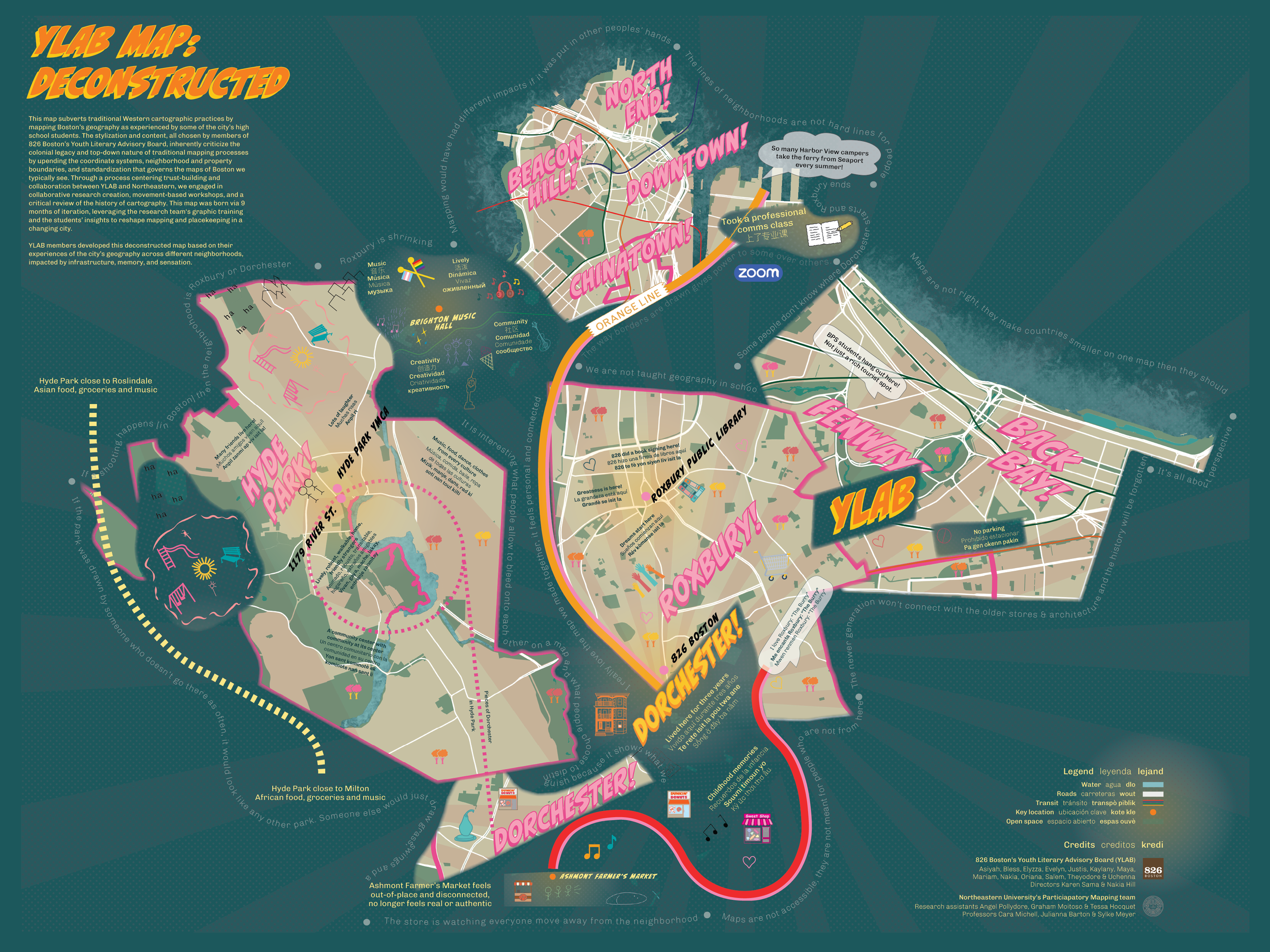
Erasure knows no age; even Boston youth see their community landmarks slipping away. In a collaboration with the youth writing nonprofit 826 Boston, Michell and her colleagues set out to make a map with local high schoolers that represented their lives in the city.
Together, they deconstructed the traditionally recorded landscape of Boston and rebuilt it until it matched the students’ perception. They stretched some city blocks and shrunk others. They annotated along the landscapes, scribbling notes ranging from “the store is watching everyone move away from the neighborhood" to “a community center with community at its center”.
Cara Michell
Youth Literary Advisory Board (YLAB) Map | 826 Boston, 2021
Image courtesy of the artist
“It's exciting to be able to represent a part of your life on a map,” Michell said.
This type of community cartography and public debate, she says, is key to decolonizing maps and public space.
While the Accelerator is Michell’s first venture into public art, she is no stranger to the public sphere. After her undergraduate days, urban planning had promised to be the perfect culmination of her degrees in visual arts, art history, and urban studies. Michell, however, was wary. How could she participate in a field that upholds systems of power and inequality?
To find out, Michell infiltrated the system from the inside.
She went back to school and studied urban planning at Harvard. She worked on projects that desegregated public schools and improved bike lanes in New York. To connect with individual communities, Michell attended church meetings and school events.
“I kind of got lost in this performance art piece,” Michell said. “I really desperately wanted to start committing more time and energy again to an art practice and to research.”
Now, Michell is an artist, urban planner and Assistant Professor of Race and Social Justice in the Built Environment at Northeastern University, a dream she’s had since her first guest lecture.
Michell was confident that teaching was in her future; she was less certain about making a return to Boston.
It’s been ten years since Michell first left Boston. As a graduate student at Harvard, she had moved northeast expecting an open and accepting environment, a city that lived up to its liberal reputation.
“I was confronted with a type of racism that I had never experienced anywhere else,” Michell said. “The kind of the silence around it in Boston really shocked me and made me feel like I was crazy.”
While it is no secret that Boston has a long way to go, the city seems to have grown in her absence.
“Coming back, I have to say that I have noticed so many changes. I feel so much more welcome,” Michell said. “I've had the time and the opportunity to give the city more of a chance and to spend time in historic neighborhoods like Roxbury and Dorchester that have a long history of being really diverse and multicultural.”
Roxbury, it so happens, is where Michell’s Accelerator project is set to take place.
Although much of her current work revolves around social practice, Michell’s artistic roots lie in sculpture and larger scale projects.
“The medium I've been mostly working with for the last four years is facilitation,” Michell said. “I had started to lose connection, my relationship, to material.”
As she turns her practice 3D in preparation for her Accelerator project, Michell is feeling like a maker once more. From the beginning, Michell had a vision for this project: pockets of memory.
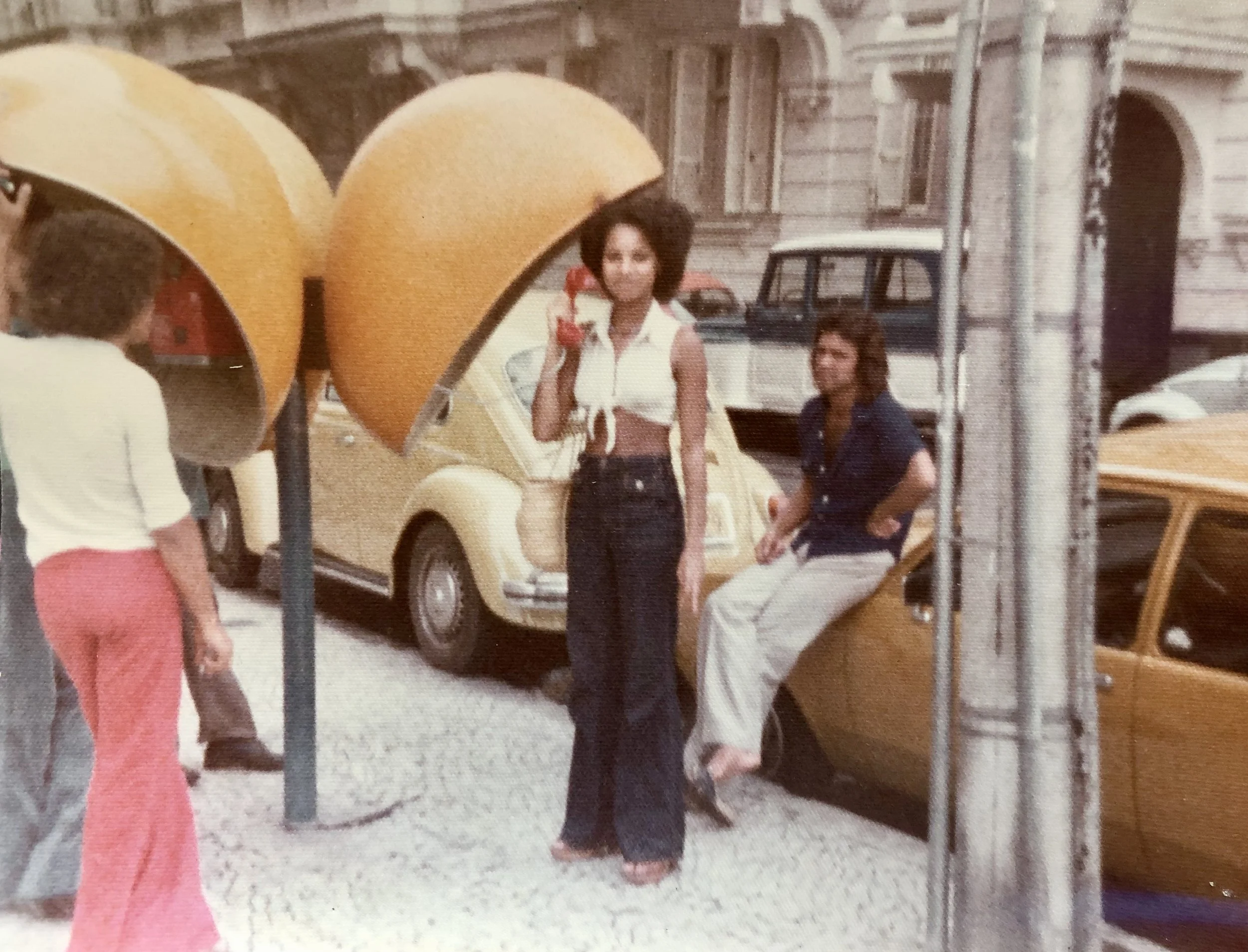
Michell’s mother standing by Chu Ming Silveira’s International “Orelhão” payphone in Brazil, 1974
Image courtesy of the artist
Fusing international recognizability with the hyperlocal, Michell seeks to draw a connection across time, age, and continent. Unlike the maps that divide and erase, her project will chronicle community history. Instead of casting the past into the shadows, it will illuminate lived experiences.
Inspired by the Orelhão payphones of Brazil and the historic lampposts that line Boston’s streets, Unwinding Time: Lanterns for Lost Places will offer a beacon of brightness, a local anecdote, and a deeply personal moment in a profoundly public space.
“I hope people will have a sense of recognition and delight,” Michell said. “That familiar feeling that is going home.”
Find more of Michell’s work at caramichell.com or on Instagram at @michellcara and @slowpractice.nyc.
Written by Nataleigh Noble, Communications Assistant at the Boston Public Art Triennial.
